Get to Know Us
Follow us on your favorite social media



Learn more about the West Oakland Farm Park
Donate
Your contribution is 100% tax deductible. You can donate by clicking the button below, or by writing a check payable to "City Slicker Farms" and mailing it to the following address:
City Slicker Farms
1625 16th Street
Oakland, CA 94607

Partnering with Planting Justice to Build Sustainable Food Systems
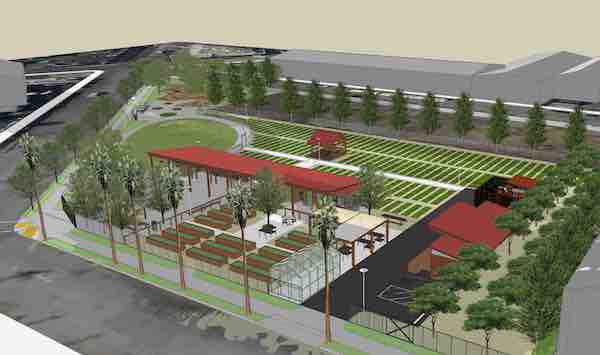
One of the most exciting parts about opening the West Oakland Urban Farm and Park will be the partnerships that come to life there; with an outdoor classroom, an educational kitchen, and plenty of public event space, the Farm Park will be a place for community groups to gather and learn.
But the partnerships aren’t only starting at opening weekend — the construction process itself has been an opportunity for collaboration across organizations. One such partnership our staff has been thrilled about is with our friends at Planting Justice. Planting Justice’s Transform Your Yard (TYY) program builds edible landscapes, sending in a team of experienced permaculture designers and landscapers, many of whom were formerly incarcerated.

A Planting Justice TYY team, led by Permaculture Designer and Site Leader Salvador Mateo, has been working at the Farm Park for the past several weeks, installing the irrigation portion of the project. Salvador explained that the job is an exciting opportunity for his team.
“We already do irrigation systems, but at a smaller level: residential,” he said. “This is more of a higher level for us than we’ve ever done. It’s great to be able to learn from it and to carry a project this big through.”
Salvador has been working at Planting Justice since he was in high school, originally joining the team during a very challenging period in his life.
“My mom got deported when I was a senior in high school — I grew up without a father, as my father got deported when I was four — so as soon as my mom got deported, I had my little sister to take care of,” he said. “It became a little difficult, but Planting Justice was there when I needed them and as soon as I graduated from high school, they promised me a job, and they delivered.”
He said that one of the most rewarding parts of his job is his coworkers.
“I’ve been here for about five years working alongside my amazing coworkers almost every day,” he said. “To have men who are twice my age or triple my age be right behind me and see me with the respect that I see them, means a lot to me.”
And his coworkers feel the same: excited about their work and grateful to be part of such a supportive team.
“Planting Justice saved my life,” said Salvador’s coworker, TYY Landscaper Darryl Aikens. “If it wasn’t for me [gardening] in San Quentin and coming out and meeting people from Planting Justice, I probably would have been back to jail.”
Darryl explained that he spent six years in San Quentin, and it was there that he joined a gardening class, through which he connected with Planting Justice.
“It’s not just a learning experience — it’s a cultural experience for me, because in my background, and what I did in my life, it’s a whole 360 degree turn,” he said. “Right now, every day when I go to work, I can see the happiness on my mother’s face.”
Darryl has learned more than he can list during his time working at Planting Justice — “how to deal with other people, how to go to a 9 to 5, how to be on time, how to interact with other coworkers” — but one of the most measurable changes to his life has been his income.
“When I was in jail, I made thirteen cents an hour,” he said. “I make more in one day than I made in a year at San Quentin. And I worked for six straight years in there! On my off days!”
For all the members of the team, though, the benefit of doing this work is much more than monetary. TYY Landscaper Dana Mitchell, who has been in the construction industry for over a decade, said that it’s the goal of this work that makes it so rewarding.
“It’s the same type of work but it’s a different aim,” he said. “The work I used to do was for financial, commercial stuff. Coming out here feels better because you’re trying to help people help themselves, to know that there’s a different option better than what we’re accustomed to. That’s what makes you want to come to work everyday. Everyone is happy about doing what they do.”
And, as he pointed out, the work of creating sustainable food systems shouldn’t be as revolutionary as it often is.
“I think it just should be a way of life,” he said. “I mean, yeah, you should like it too, but to eat good food should be normal. I think I’m just doing what should be the norm for everybody.”